
Key Takeaways
- Definition: Beef cattle (bovine animals) ke meat ko kehate hain. Culinary science mein ise red meat ki category mein rakha jata hai.
- Primary Composition: Isme high-quality complete protein, heme iron, Vitamin B12, zinc, aur essential fatty acids hote hain.
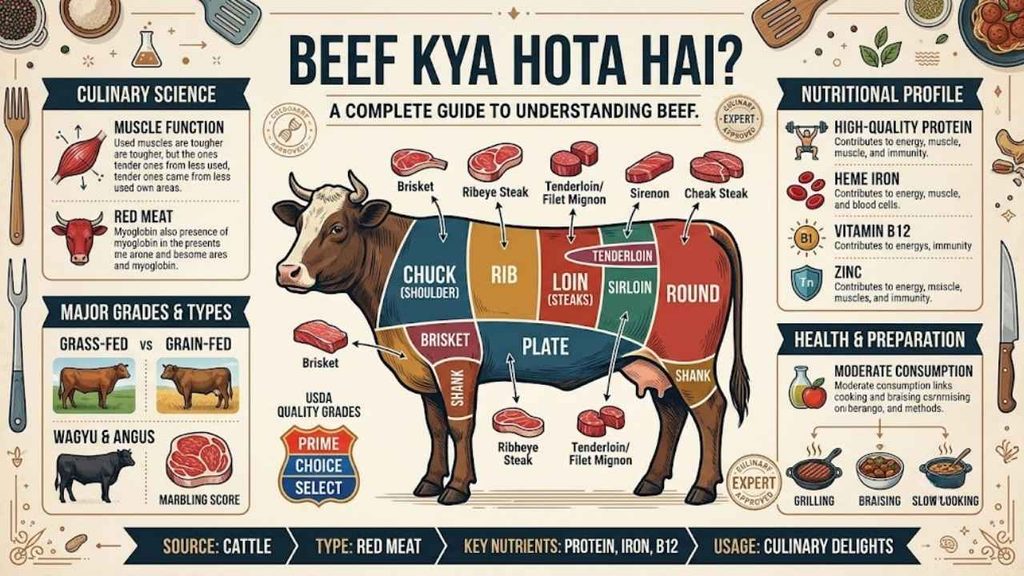
- Popular Cuts: Ribeye, Tenderloin (Filet Mignon), Sirloin, Brisket, aur Chuck.
- Major Feed Types: Grass-fed (lean, earthy flavor) aur Grain-fed (rich marbling, tender texture).
- Global Grading: USDA Prime, Choice, aur Select standards marbling aur age ke basis par meat quality decide karte hain.
1: Beef Kya Hota Hai? (Scientific & Culinary Definition)
Jab hum culinary science aur food technology ki baat karte hain, toh beef ka matlab hota hai mature cattle (Bos taurus ya Bos indicus) ka culinary meat. Food classification ke hisab se ise red meat mana jata hai kyunki iske muscle tissue mein myoglobin naam ka protein high concentration mein hota hai. Myoglobin oxygen ko muscle cells tak pahunchata hai, jisse pakaney se pehle meat ka rang deep red dikhta hai.
Bovine Family Aur Basic Categorization
Cattle family (bovine) mein meat ko uski age aur source ke hisab se alag-alag terms se jana jata hai:
- Beef: Mature cattle (chaho wo steer ho ya heifer) ka meat jo generally 18 se 24 mahine ki umar ke baad process kiya jata hai. Iska flavor deep, robust, aur rich hota hai.
- Veal: Young calves (bacchon) ka meat. Iska color pale pink hota hai, texture bohot delicate hota hai, aur flavor subtle hota hai.
- Ox / Bull Meat: Fully mature male cattle ka meat jo mainly slow cooking ya ground meat ke roop mein use hota hai kyunki iske muscle fibers kafi tough hote hain.
       Bovine Animals (Cattle Family)
                     │
     ┌───────────────┴───────────────┐
     ▼                               ▼
Young Calves (< 20 weeks)    Mature Cattle (18-24 months)
     │                               │
     ▼                               ▼
   Veal                            Beef
(Pale, Tender)              (Deep Red, Marbled)
Red Meat vs White Meat: Culinary Science Perspective
Food industry mein meat ko myoglobin content ke basis par do main categories mein baata gaya hai:
| Property | Red Meat (e.g., Beef) | White Meat (e.g., Chicken Breast) |
| Myoglobin Level | High (> 0.8%) | Low (< 0.05%) |
| Iron Form | Highly Bioavailable Heme Iron | Non-Heme & Low Heme Iron |
| Fat Distribution | Intramuscular (Marbling) | Subcutaneous (Under skin) |
| Cooking Reaction | High Maillard Browning | Mild Browning |
| Flavor Profile | Umami, Rich, Savory | Mild, Neutral |
Culinary perspective se beef ka sabse bada feature iski marbling (intramuscular fat) aur collagen network hai. Marbling meat ke fibers ke beech chota-chota white fat deposit hota hai. Jab aap heat apply karte hain, toh yeh fat melt ho kar meat ko juicy, tender, aur flavorful banata hai.
2: History and Global Evolution
Beef ka human civilization ke sath rishta hazaron saal purana hai. Food anthropology ke hisab se, humans ne Aurochs (wild cattle ancestors) ka shikar Paleolithic era se hi shuru kar diya tha. Modern beef cattle ki domestication lagbhag 10,000 saal pehle Near East aur Indian Subcontinent mein shuru hui thi.
10,000 BCE               Middle Ages               19th Century              Modern Era
 Domestication      ───►  Draft Animals &    ───►  Industrialized     ───►  Gourmet Grading &
  (Near East)             Local Consumption         Refrigerated Transport       Wagyu Breeding
1. Ancient Civilizations Aur Pastoral Culture
Ancient Mesopotamia, Egypt, aur Roman Empire mein cattle ko pehle farming, milk, aur draft power ke liye use kiya jata hai. Time ke sath, jab agricultural surplus badha, tab specific cattle breeds ko meat production ke liye breed karna shuru kiya gaya. Roman culinary manuscripts (Apicius) mein seasoned aur roasted beef dishes ke milte hain.
2. Medieval Europe Aur Culinary Hierarchy
Middle Ages ke dauran Europe mein beef luxury status symbols mein shamil ho gaya. Knights aur aristocrats thick-cut roasts khate the, jabki common population working cattle ka meat khate the jise hours tak slow-boil (stewing) karna padta tha. Is dauran European countries ne specific breeds, jaise United Kingdom mein Hereford aur Angus, develop kiye.
3. Industrial Revolution Aur Global Trade
19th Century mein do bare inventions ne global beef industry ko badal kar rakh diya:
- Steam Engine & Railways: Cattle ko pastures se urban markets tak efficiently transport karna possible hua.
- Refrigerated Shipping (Reefer Ships): Is technology ki wajah se Argentina, Australia, aur United States se fresh red meat Europe aur Asia ke markets tak export hona shuru hua.
4. Modern Culinary Diversity
Aaj global culinary map par har culture ka beef cook karne ka apna ek scientific aur traditional tarika hai:
- North America: Low-and-slow Pit Barbecue (Texas Brisket) aur High-Heat Pan Seared Steaks.
- South America (Argentina/Brazil):Asado aur Churrasco – open-flame wood charcoal grilling.
- East Asia (Japan/Korea): High-marbling thin slices jaise Yakiniku, Sukiyaki, aur K-BBQ (Bulgogi).
- Europe (France/Italy): Classic French braising techniques jaise Boeuf Bourguignon aur Italian dry-aged steaks (Bistecca alla Fiorentina).
3: Types of Beef (Grass-fed, Grain-fed, Wagyu & Angus)
Sabhi beef ek jaisa nahi hota. Cattle ki breed, uski diet, aur rearing conditions meat ki tenderness, flavor profile, fatty acid composition, aur price par direct impact dalti hain.
1. Grass-Fed Beef
Grass-fed cattle poori zindagi pasture par natural ghaas (grass) aur forage khate hain.
- Flavor Profile: Earthy, gamey, aur slightly mineral flavor.
- Texture: Lean hota hai, jisme intramuscular fat (marbling) kam hota hai.
- Nutritional Edge: Isme Omega-3 fatty acids, Conjugated Linoleic Acid (CLA), aur Vitamin E ki quantity grain-fed ke muqable zyadah hoti hai.
2. Grain-Fed Beef
Grain-fed cattle apni life ka shuruaati hissa pasture par bitate hain, lekin last 100-200 din unhe feedlots mein high-calorie diet (Corn, Soy, Grains) di jaati hai.
- Flavor Profile: Butter-like, rich, aur sweet umami taste.
- Texture: Bohot tender aur juicy, kyunki grain diet se rapid fat deposition hota hai.
- Popularity: Global commercial market aur western steak-houses mein grain-fed beef sabse zyadah popular hai.
3. Wagyu Beef
Wagyu (和牛) ka matlab hai “Japanese Cattle”. Yeh special Japanese breeds hote hain (sabse famous Kobe, Matsusaka, aur Omi) jinki genetics mein natural taur par extreme intramuscular fat deposition hota hai.
- Flavor Profile: Exceptionally rich, melt-in-your-mouth texture, jisme intense buttery notes hote hain.
- Science of Fat: Wagyu fat ka melting point human body temperature (~37°C) se kam hota hai. Iska matlab hai ki fat muh mein rakhte hi melt hone lagta hai.
- Monounsaturated Fat: Isme unsaturated fatty acids (Oleic acid) ki percentage normal beef se bohot high hoti hai.
4. Angus Beef
Angus (Aberdeen Angus) Originally Scotland ki breed hai jo ab United States, Australia, aur Argentina mein dominant hai.
- Consistency: Angus beef apne consistent marbling, deep color, aur balanced flavor profile ke liye poori duniya mein mashhoor hai.
- Certified Angus Beef (CAB): Industry ka ek strict quality benchmark hai jo meat ki tenderness aur flavor standard ko guarantee karta hai.
Detailed Comparison Table: Beef Varieties
| Attribute | Grass-Fed Beef | Grain-Fed Beef | Wagyu Beef (A5 Grade) | Angus Beef |
| Primary Diet | Natural Pasture Grass | Corn, Barley, Soy Feed | Special Grain & Beer Mash | Mixed Pasture & Grain |
| Marbling Level | Low (Lean) | Moderate to High | Extremely High (Spider-web) | High & Consistent |
| Fat Melting Point | High (~42°C) | Medium (~39°C) | Very Low (~25°C – 30°C) | Medium (~38°C) |
| Texture | Chewy, Firm | Tender, Soft | Dissolves in mouth | Tender & Juicy |
| Flavor Intensity | Earthy, Mineral | Rich, Buttery | Intense Umami, Buttery | Balanced & Beefy |
| Omega-3 Ratio | High | Low | Moderate | Moderate |
| Best Cooking Method | Low heat, quick searing | High heat grilling, searing | Gentle searing (Thin cuts) | Pan-sear, Grilling, Roast |
4: Complete Guide to Beef Cuts (Primal & Sub-Primal Cuts)
Culinary science mein cattle carcass ko primary structural sections mein divide kiya jata hai, jinhe Primal Cuts kehte hain. Un primal cuts ko aage butcher karke market-ready individual portions mein kata jata hai, jinhe Sub-Primal Cuts ya retail cuts kehte hain.
Muscle function ka direct relationship meat ki tenderness se hota hai: jo muscles animal ke weight ko support karte hain ya constantly walk/move karne mein use hote hain (jaise Shoulder aur Leg), unme collagen aur connective tissue high hota hai, jisse wo tough hote hain. Jo muscles animal ki spine ke paas hote hain aur kam work karte hain (jaise Loin aur Rib), wo exceptionally tender hote hain.
                  ┌─────────────────────────────────────────┐
                  │              Bovine Carcass             │
                  └────────────────────┬────────────────────┘
                                       │
            ┌──────────────────────────┴──────────────────────────┐
            ▼                                                     ▼
     Forequarter (Front)                                  Hindquarter (Back)
 ┌───────────────────────┐                             ┌───────────────────────┐
 │ • Chuck (Shoulder)    │                             │ • Loin (Tender/Short) │
 │ • Rib (Mid-Spine)     │                             │ • Sirloin (Hip)       │
 │ • Brisket (Chest)     │                             │ • Round (Rear Leg)    │
 │ • Plate & Shank       │                             │ • Flank (Abdomen)     │
 └───────────────────────┘                             └───────────────────────┘
Detailed Breakdown of Major Primal & Sub-Primal Cuts
1. Rib Section (Sub-primal: Ribeye, Prime Rib, Cowboy Cut)
- Anatomy: Animal ke mid-spine aur ribs (Ribs 6 through 12) ke paas ka region.
- Character: High marbling, exceptional tenderness, aur deep beefy flavor.
- Ribeye: Rib section ka sabse famous steak cut. Isme Spinalis Dorsi (Ribeye Cap) muscle hota hai jo overall beef ka sabse flavorful aur tender muscle maana jata hai.
- Best Culinary Use: High-heat pan searing, cast-iron cooking, aur charcoal grilling.
2. Loin Section (Sub-primal: Tenderloin/Filet Mignon, Striploin/NY Strip, T-Bone, Porterhouse)
- Anatomy: Animal ke lower back aur spine ke dono taraf ka portion.
- Tenderloin (Filet Mignon): Yeh muscle (Psoas Major) spine ke andar hota hai aur lagbhag zero heavy exercise karta hai. Is wajah se yeh poore animal ka sabse tender cut hota hai, jabki isme fat aur marbling low hoti hai.
- Striploin (New York Strip): Tenderloin ke opposite side ka muscle. Isme tight grain pattern aur side par fat cap hota hai jo intense flavor deta hai.
- T-Bone & Porterhouse: In cuts mein center par ‘T’ shaped bone hoti hai—ek taraf Striploin aur dusri taraf Tenderloin ka section hota hai.
3. Chuck Section (Sub-primal: Chuck Roast, Flat Iron, Denver Cut)
- Anatomy: Animal ka shoulder aur neck area.
- Character: Constantly active muscles, heavy connective tissues (collagen), aur rich fat distribution.
- Flat Iron Steak: Chuck section se nikala gaya ek modern cut jo Tenderloin ke baad second most tender cut mana jata hai (agar center line sinew ko remove kar diya jaye).
- Best Culinary Use: Pot roasts, stews, braising, aur grinding for high-fat burger patties (80/20 lean-to-fat ratio).
4. Brisket Section (Sub-primal: Point Cut, Flat Cut)
- Anatomy: Animal ke front chest area ke breast muscles jo body ka lagbhag 60% weight support karte hain.
- Character: Dense muscle fibers aur thick collagen matrix. Direct high heat par pakane se yeh cut tough aur rubbery ho jata hai.
- Best Culinary Use: Low-and-Slow smoking (Texas Style BBQ) ya wet braising (Corned Beef/Pastrami). Slow cooking se hard collagen breakdown ho kar soft gelatin mein convert ho jata hai.
5. Sirloin & Round Sections (Sub-primal: Top Sirloin, Rump, Eye of Round)
- Anatomy: Animal ke hip aur rear legs ka portion.
- Character: High protein density, extremely lean, aur minimal marbling.
- Best Culinary Use: Thin slicing for stir-fries, roasting medium-rare, slow-cooking, ya lean ground meat (90/10 ratio).
6. Flank & Skirt Sections (Sub-primal: Inside Skirt, Flank Steak)
- Anatomy: Abdominal wall muscles.
- Character: Long, coarse muscle fibers, loose grain, aur high surface area.
- Best Culinary Use: Marinating and flash-grilling over ultra-high heat (Fajitas, Carne Asada). Muscle grain ke crosswise (across the grain) cut karna essential hota hai.
5: Meat Grading & Quality Standards
Meat industry mein grading consumer ko guarantee deti hai ki meat ki tenderness, flavor, aur overall eating experience kaisa hoga. Global level par United States Department of Agriculture (USDA) ka grading system sabse widely recognized benchmark hai.
                   USDA Quality Grading Scale

    ┌──────────────────────────────────────────────────────┐
    │  PRIME   │ High Marbling, Abundant Fat, Prime Steaks │
    ├──────────┼───────────────────────────────────────────┤
    │  CHOICE  │ Moderate Marbling, High Quality Retail    │
    ├──────────┼───────────────────────────────────────────┤
    │  SELECT  │ Low Marbling, Lean, Budget Cut            │
    └──────────┴───────────────────────────────────────────┘
1. USDA Quality Grading System
USDA Quality Grading do main factors par dependent hoti hai: Intramuscular Marbling (muscle ke andar fat distribution) aur Maturity (animal ki age at slaughter).
- USDA Prime: Peak commercial quality grade. Faat distribution (marbling) extremely dense aur uniform hoti hai. Total commercial beef production ka sirf 3% – 5% hi Prime grade qualify karta hai. Top-end steak-houses mein yeh grade server hota hai.
- USDA Choice: Substantial marbling level. Extremely juicy aur tender hota hai. Retail supermarkets aur high-end casual dining mein Choice grade sabse popular options mein se ek hai.
- USDA Select: Leaner option jisme fat density kafi kam hoti hai. Tenderliness Choice ya Prime ke muqable kam hoti hai. Low-heat moist cooking methods ya marinade techniques ke sath best result deta hai.
2. Japanese Meat Grading Scale (JMGA) – A1 to A5 Scale
Wagyu beef ke liye World-Standard grading system JMGA (Japan Meat Grading Association) dwaara chalta hai. Isme do components hote hain:
- Yield Grade (A, B, C): Carcass se kitna usable meat obtain hota hai (A = Highest Yield).
- Quality Grade (1 to 5): Based on Marbling score (BMS – Beef Marbling Standard), Meat Color, Fat Color, aur Texture.
     BMS Score Range (Beef Marbling Standard)

     BMS 1-2   ──► Grade 1/2 (Standard)
     BMS 3-4   ──► Grade 3   (Average)
     BMS 5-7   ──► Grade 4   (Premium)
     BMS 8-12  ──► Grade A5  (Ultra-Premium / Extreme Marbling)
Grade A5 highest standard hai jisme BMS scale 8 se 12 tak hota hai. Is level par meat mein fat matrix structural muscle fibers par dominate karta hai.
6: Culinary Cooking Methods & Thermal Science
Beef cooking ka core principle muscle proteins ka denaturation aur collagen degradation controlling heat application ke dwara manage karna hai.
Muscle Proteins & Temperature Thresholds
 50°C (122°F)      60°C (140°F)      65°C (149°F)      70°C+ (158°F+)
 Myosin Denatures  Myoglobin Shifts  Actin Shrinks     Collagen Melts
      │                 │                 │                 │
      ▼                 ▼                 ▼                 ▼
 Rare (Soft)       Medium (Pink)    Well Done (Dry)   Gelatin Formation
- Myosin Denaturation (~50°C / 122°F): Muscle fibers soften hona shuru hote hain.
- Myoglobin Oxidation (~60°C / 140°F): Meat ka internal color bright red se pink/brown shift hota hai.
- Actin Denaturation (~65°C / 149°F): Muscle fibers tightly squeeze hote hain, jisse natural juices release hone lagte hain.
- Collagen Hydrolysis (68°C – 82°C / 155°F – 180°F): Tough connective tissue break down ho kar liquid gelatin ban jata hai.
Key Cooking Methods
A. High-Heat Direct Dry Methods (Steaks & Tender Cuts)
- Pan-Searing (Cast Iron): High heat (~200°C+) par pan mein meat ko quick sear karna. Is process mein Maillard Reaction hoti hai—jo meat ke amino acids aur sugars ke reaction se crust, rich brown color, aur deep aroma release karti hai.
- Grilling: Open flame / charcoal heat ka direct application. High heat se fat render ho kar coals par girta hai, jisse smoke create hoti hai aur meat ko distinctive charcoal flavor milta hai.
- Reverse Sear Technique: Thick steaks (1.5 inch+) ke liye best scientific method. Pehle meat ko low temperature oven/smoker (105°C) mein seared target internal temp tak bring karte hain, fir end mein smoking-hot skillet par 1 minute per side sear karke perfect crust paate hain.
B. Low-and-Slow Wet/Moist Methods (Tough & Collagen-Rich Cuts)
- Braising & Stewing: Liquid (broth, stock) mein cover karke slow temperature (90°C – 100°C) par hours tak cook karna. Chuck, Shank, aur Short Ribs ke liye absolute best method hai kyunki collagen slow hydrolysis se completely soft gelatin ban jata hai.
- Smoking (Low-and-Slow Barbecue): Indirect heat (100°C – 120°C) par hardwoods (Hickory, Oak) ki smoke se prolonged cooking karna. Brisket jaise heavy cuts ko melt-in-mouth texture dene ka standard method hai.
Internal Doneness Temperature Guide
| Doneness Stage | Internal Temp (°C / °F) | Center Appearance | Texture Profile |
| Rare | 52°C – 55°C (125°F – 130°F) | Deep Red, Warm Center | Extremely Soft, High Juiciness |
| Medium-Rare | 55°C – 60°C (130°F – 140°F) | Warm Red to Deep Pink | Ideal Balance of Flavor & Tenderness |
| Medium | 60°C – 65°C (140°F – 150°F) | Warm Pink Center | Firm, Moderately Juicy |
| Medium-Well | 65°C – 70°C (150°F – 160°F) | Slight Pink Hint | Firm, Dry Exterior |
| Well-Done | 70°C+ (160°F+) | Solid Gray-Brown | Very Firm, Minimal Juices |
Culinary Food Safety Note: USDA recommendation ke mutabiq intact whole muscle steaks ko minimum internal temperature 63°C (145°F) with 3-minute rest time tak cook karna standard food safety practice hai. Ground beef (keema) ko continuous minimum internal temp 71°C (160°F) tak cook karna safety critical hai kyunki grinding process exterior surface bacteria ko internal matrix mein mixing kar deta hai.
7: Complete Nutritional Profile
Scientific perspective se beef ek dense micronutrient-rich power food hai. Isme sabse notable aspect high biological value (HBV) complete protein ki presence hai, jiska matlab hai ki isme wo sabhi 9 essential amino acids hote hain jo human body khud synthesize nahi kar sakti.
Iske ilawa, beef mein minerals aur vitamins aisi biological state mein milte hain jo plant-based sources ke muqable human gut dwara significantly zyadah absorb hote hain.
                   Nutritional Density Matrix (Per 100g)

     ┌────────────────────────────────────────────────────────┐
     │ Protein       │ 26g - 28g  (Complete Essential Amino) │
     ├───────────────┼────────────────────────────────────────┤
     │ Iron          │ 2.6mg      (100% Bioavailable Heme)   │
     ├───────────────┼────────────────────────────────────────┤
     │ Vitamin B12   │ 2.6mcg     (108% Daily Value)          │
     ├───────────────┼────────────────────────────────────────┤
     │ Zinc          │ 6.0mg      (55% Daily Value)           │
     └────────────────────────────────────────────────────────┘
Nutritional Breakdown Table (Per 100 Grams Serving)
Niche raw vs cooked cooked profiles ka standard average baseline diya gaya hai:
| Nutrient | Lean Grass-Fed Beef (100g Cooked) | Grain-Fed Beef (100g Cooked) | Daily Value (DV) % |
| Calories | ~198 kcal | ~250 kcal | 10% – 12% |
| Complete Protein | 28.5 g | 26.0 g | 52% – 57% |
| Total Fat | 8.0 g | 15.0 g | 10% – 20% |
| Saturated Fat | 3.2 g | 6.1 g | 15% – 30% |
| Monounsaturated Fat | 3.5 g | 6.8 g | — |
| Heme Iron | 2.7 mg | 2.4 mg | 15% |
| Zinc | 6.2 mg | 5.8 mg | 55% – 60% |
| Vitamin B12 (Cobalamin) | 2.8 mcg | 2.5 mcg | 100%+ |
| Vitamin B3 (Niacin) | 6.5 mg | 5.8 mg | 35% – 40% |
| Vitamin B6 | 0.6 mg | 0.5 mg | 30% |
| Creatine | 350 mg – 500 mg | 350 mg – 500 mg | — |
| Conjugated Linoleic Acid (CLA) | High (~5mg/g fat) | Moderate (~2mg/g fat) | — |
Key Bioactive Compounds Explained
1. Heme Iron vs Non-Heme Iron
Plant sources (spinach, beans) mein non-heme iron hota hai, jiska human absorption rate lagbhag 2% se 20% hota hai. Beef mein primary iron heme iron form mein hota hai, jiska gut absorption rate 15% se 35% tak hota hai. Yeh ferritin levels aur hemoglobin rapidly maintain karta hai.
2. Creatine & Carnosine
- Creatine: Direct cellular energy supply (ATP regeneration) karta hai, jisse muscle strength, power output, aur cognitive sharpness support hoti hai.
- Carnosine: Internal muscle tissue buffering agent ki tarah act karta hai, jo intense workout ya physical labor ke dauran lactic acid accumulation ko delay karta hai.
3. Fatty Acid Composition
Beef fat mein primary fatty acids Oleic Acid (wahi monounsaturated fat jo olive oil mein milta hai), Stearic Acid, aur Palmitic Acid hote hain. Stearic acid blood cholesterol levels par neutral impact ke liye jana jata hai.
8: Health Benefits & Moderate Consumption Guidelines
Nutritional epidemiology aur dietary science ke according, lean beef ko balanced diet mein include karne ke specific biological benefits hain.
                      Health Mechanism Architecture

   ┌─────────────────────────────────────────────────────────────┐
   │ Complete Protein  ──► Muscle Protein Synthesis (Leucine)     │
   ├─────────────────────────────────────────────────────────────┤
   │ Heme Iron + B12   ──► Anemia Prevention & Red Blood Cells   │
   ├─────────────────────────────────────────────────────────────┤
   │ Zinc + Selenium   ──► Immune Function & Hormonal Balance   │
   └─────────────────────────────────────────────────────────────┘
Key Health Benefits
1. Muscle Mass Maintenance & Sarcopenia Prevention
Beef mein high concentration mein Leucine amino acid hota hai, jo mTOR pathway ko trigger karke Muscle Protein Synthesis (MPS) ko directly stimulate karta hai. Age-related muscle loss (sarcopenia) aur athletic recovery ke liye high-grade amino acids critical hain.
2. Prevention of Iron-Deficiency Anemia
Globally anemia micro-nutrient deficiency ka sabse bada reason hai. Heme iron and Vitamin B12 ka synergistic combination red blood cell synthesis aur oxygen transport efficacy ko optimum state mein rakhta hai.
3. Immune System Support & Metabolic Function
100g beef daily zinc requirement ka over 50% cover karta hai. Zinc T-cell function, DNA synthesis, wound healing, aur metabolic enzymatic activity ke liye foundational mineral hai.
Moderate Consumption Guidelines & Portion Control
Health organizations (World Cancer Research Fund & Dietary Guidelines) metabolic efficiency aur cardiovascular health maintain karne ke liye specific limits suggest karti hain:
- Recommended Weekly Limit: Approx 350g to 500g (cooked weight) of red meat per week.
- Portion Control: Per meal ideal serving size 100g to 150g (palm-sized portion) honi chahiye.
- Preparation Focus: Heavy deep-frying ya charring/blackening (over-flame burning) ko avoid karna chahiye, kyunki high heat par charred surface par Heterocyclic Amines (HCAs) aur Polycyclic Aromatic Hydrocarbons (PAHs) form hote hain. Gentle searing, braising, aur roasting superior methods hain.
9: Storage, Hygiene & Safety Guidelines
Red meat ki moisture aur protein composition isse high-risk perishable food banati hai. Micro-organism multiplication stop karne ke liye strict temperature control essential hai.
                       Temperature Danger Zone

         ┌──────────────────────────────────────────────┐
         │  Danger Zone: 4°C to 60°C (40°F to 140°F)   │
         │  Bacterial Growth Rapidly Accelerates!       │
         └──────────────────────────────────────────────┘
1. Temperature Control Matrix
- Refrigeration (0°C to 4°C / 32°F to 40°F): Fresh raw steaks, roasts, aur whole cuts ko 3 to 5 days ke andar cook kar lena chahiye. Ground beef (keema) maximum 1 to 2 days ke andar consume hona chahiye kyunki grinding surface exposure badha deti hai.
- Freezing (-18°C or lower / 0°F): Whole muscle cuts 6 to 12 months tak safe rehte hain bina quality degradation ke. Ground beef 3 to 4 months tak vacuum-sealed container mein maintain rehta hai.
2. Preventing Cross-Contamination & Hygiene Protocols
- Separate Boards & Knives: Raw red meat handle karne ke liye dedicated color-coded cutting board (e.g., Red Board) use karein. Raw meat utensils ko cooked food, salad, ya ready-to-eat items ke contact mein na aane den.
- Safe Defrosting (Thawing) Science:
- Refrigerated Thawing (Best Method): Meat ko freezer se nikalke 24 hours pehle fridge main shift karein. Cell structure damange nahi hota aur temperature food-safe zone mein rehta hai.
- Cold Water Thawing: Sealed leak-proof bag ko har 30 minute mein badle jane wale thande pani mein dip karein.
- Never: Room temperature counter par open thawing na karein—yeh exterior surface ko Danger Zone (4°C-60°C) mein ghantoo tak chor deta hai jahan E. coli aur Salmonella multiply ho sakte hain.
10: Frequently Asked Questions (PAA Snippet Optimized)
Q1: Beef kya hota hai?
Ans: Beef cattle (bovine animals) ke muscle meat ko kehte hain. Culinary classification mein high myoglobin content hone ki wajah se ise red meat mana jata hai. Isme complete protein, heme iron, Vitamin B12, aur zinc rich quantity mein milta hai.
Q2: What is the primary difference between Beef and Veal?
Ans: Beef mature cattle (18-24 months) ka meat hota hai jiska color deep red aur flavor intense hota hai. Veal young calves ka meat hota hai jo exceptionally pale pink, delicate, aur mild flavor ka hota hai.
Q3: Grass-fed aur Grain-fed beef mein kya farak hota hai?
Ans: Grass-fed beef natural pasture grass par feed hone ki wajah se lean, lower-fat, aur earthy flavor ka hota hai. Grain-fed beef ko high-calorie grain diet di jaati hai, jisse isme rich marbling, tender texture, aur buttery flavor milta hai.
Q4: Steak cooking mein Marbling kya hoti hai aur iska kya roll hai?
Ans: Marbling muscle fibers ke andar deposited intramuscular fat white flecks hote hain. Cooking ke dauran marbling melt ho kar meat ko juiciness, natural moisture, tenderness, aur umami flavor profile provide karti hai.
Q5: Beef ko kis internal temperature tak cook karna safe hota hai?
Ans: Whole muscle steaks ko standard food safety ke liye minimum 63°C (145°F) internal temperature tak cook karke 3 minute rest dena chahiye. Ground beef (keema) ko continuous minimum 71°C (160°F) tak cook karna mandatory hai.
Q6: Wagyu beef itna expensive aur soft kyu hota hai?
Ans: Wagyu special Japanese cattle breeds se aata hai jinki genetic characteristic extreme intramuscular marbling (BMS) deposit karna hai. Wagyu fat ka melting point human body temperature se kam hota hai, jisse yeh melt-in-mouth texture deta hai.
Q7: USDA Prime, Choice, aur Select grading scale kya measure karti hai?
Ans: USDA scale meat ki commercial quality measure karti hai. Prime highest marbling aur tenderness dikhati hai, Choice high retail quality aur moderate fat balanced karti hai, jabki Select lean, low-fat option hoti hai.
Q8: Red meat mein Maillard Reaction kya hoti hai?
Ans: High heat (140°C-165°C) par jab meat ke amino acids aur reducing sugars surface par react karte hain, toh Maillard Reaction hoti hai. Isse meat ki surface par rich brown crust banti hai aur complex savory flavors unlock hote hain.
Q9: Reverse Searing cooking technique kya hoti hai?
Ans: Thick cuts ke liye use hone wali cooking technique jisme meat ko pehle low temperature oven/smoker mein slowly target internal doneness tak laya jata hai, aur end mein high-heat pan par quick sear karke ideal outer crust banayi jati hai.
Q10: Fresh beef ko kitne din tak refrigerator mein safe rakha ja sakta hai?
Ans: Raw steaks aur whole muscle roasts ko 0°C-4°C temperature par 3 se 5 days tak rakha ja sakta hai. Ground beef ko maximum 1 se 2 days ke andar cook karna recommend kiya jata hai.
Final Conclusion & Summary Checklist
Food science aur culinary management ki nazar se beef ek highly complex, highly nutritious, aur versatile food item hai. Iska culinary outcome—chahe steak ki tenderness ho ya stew ki richness—complete animal anatomy, diet classification (grass vs grain), cut Selection, aur precise thermal cooking rules par depend karta hai.
                    Culinary Mastery Summary Checklist

  [✓] Cut Matching    : Match tender muscles to dry-heat (steak/grill) and
                        tough collagen muscles to low-and-slow (braise/smoke).
  [✓] Quality Choice  : Look for balanced marbling (USDA Prime/Choice or BMS 5+).
  [✓] Temperature     : Use an instant-read thermometer for precision.
  [✓] Food Safety     : Keep out of Danger Zone (4°C-60°C); thaw safely in fridge.
Also Read:- IPL me Powerplay Kya Hota Hai? Rules, History, Strategy aur Super Records (Complete Master Guide)